
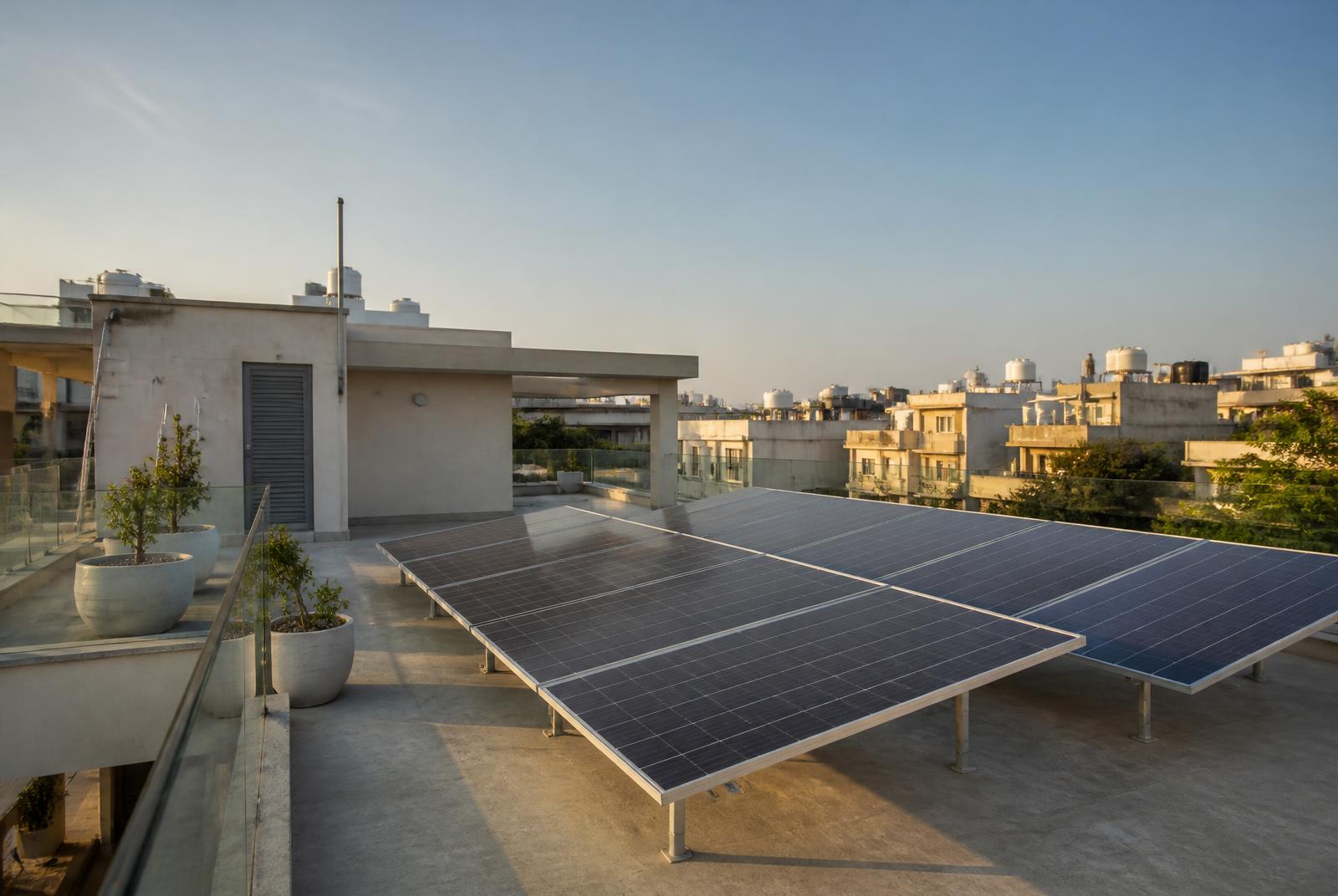
Rooftop Solar for South Delhi Homes
SolarXergy helps homeowners estimate a suitable system size, understand potential savings on their electricity bill, and arrange a site survey and installation coordination — from the first enquiry to commissioning.
- Free initial assessment, no obligation
- Indicative system size and cost
- Guidance on applicable subsidy
- Installation coordinated end to end
Savings depend on your consumption, tariff, roof conditions and system size. SolarXergy does not guarantee zero electricity bills or any specific savings amount.
Up to ₹1,08,000* solar subsidy in Delhi
*Up to ₹78,000 Central subsidy plus up to ₹30,000 Delhi Government capital subsidy for eligible residential rooftop-solar consumers, subject to applicable system capacity, scheme eligibility, DISCOM/government approval, current scheme rules and successful processing. Subsidy is not guaranteed by SolarXergy.
Eligible residential rooftop-solar customers may qualify for government subsidy under applicable schemes. Eligibility, amount and process depend on current government/DISCOM rules.
We help you understand the applicable scheme, the documents required and how your DISCOM handles the application. We do not promise any specific subsidy amount or approval, SolarXergy is not a government body and is not itself an MNRE-approved body — installation work is carried out by our solar installation partners.
South Delhi areas we cover
We take rooftop solar enquiries from homes across Greater Kailash, Defence Colony, South Extension, Green Park, Hauz Khas, Panchsheel Park, New Friends Colony, Saket, Vasant Kunj, Chittaranjan Park (CR Park), Kalkaji and Malviya Nagar, along with nearby South Delhi neighbourhoods.
- Greater Kailash
- Defence Colony
- South Extension
- Green Park
- Hauz Khas
- Panchsheel Park
- New Friends Colony
- Saket
- Vasant Kunj
- Chittaranjan Park (CR Park)
- Kalkaji
- Malviya Nagar
- Lajpat Nagar
- Vasant Vihar
- Safdarjung Enclave
- Mehrauli
- Chhatarpur
What you get with SolarXergy
Free initial solar assessment
Share your bill and roof details and we assess whether rooftop solar makes sense for your home — at no cost and with no obligation.
System-size guidance
We suggest an indicative system size based on your consumption pattern and usable shadow-free roof area.
Applicable subsidy guidance
We explain the current residential rooftop-solar subsidy process and the paperwork involved, so you know what to expect.
End-to-end installation coordination
Site survey, quotation, material, installation and DISCOM paperwork are coordinated through our solar installation partners.
Multi-brand product options
Panels, inverters and mounting structures from multiple brands, so the quote is matched to your budget instead of a single catalogue.
South Delhi focused
We work extensively across South Delhi colonies, so surveys and follow-ups are easy to schedule.
How it works
- 1
Share your bill & details
Fill the short form with your locality, monthly bill, property type and rooftop access.
- 2
Free assessment
An advisor calls you back to discuss consumption, roof suitability and an indicative system size.
- 3
Site survey & quotation
A partner engineer checks roof area, shading and meter, then you receive a written quotation.
- 4
Installation coordination
On approval, installation, commissioning and net-metering paperwork are coordinated for you.
Indicative sizing by electricity bill
A starting point only. Actual sizing is confirmed after the site survey.
| Monthly bill | Typical system | Shadow-free roof |
|---|---|---|
| Below ₹3,000 | ~2 kW | ~180 sq ft |
| ₹3,000 – ₹5,000 | ~3 kW | ~270 sq ft |
| ₹5,000 – ₹10,000 | ~5 kW | ~450 sq ft |
| ₹10,000+ | ~8–10 kW | ~720–900 sq ft |
Based on a general guideline of roughly 80–100 sq ft of shadow-free roof per kW. Not a quotation.
Why SolarXergy
Solar is all we do
Rooftop solar products and installation enquiries are our only business, so the advice you get is specific rather than generic.
Local South Delhi focus
Familiarity with South Delhi rooftops, colony layouts and the local DISCOM process makes surveys and follow-ups faster.
Transparent, multi-brand
You see options across brands with the assumptions behind the sizing spelled out — no inflated savings promises.
SolarXergy is a solar products marketplace and enquiry platform. Site survey, installation and DISCOM paperwork are carried out by our solar installation partners; warranty and service terms come from the selected partner and the equipment manufacturers.
Frequently asked questions
How much roof area do I need for a home solar system?
As a rule of thumb, allow roughly 80–100 sq ft of shadow-free roof area per kW. So a 3 kW system typically needs about 250–300 sq ft. The exact usable area and layout are confirmed during the site survey.
What electricity bill makes rooftop solar worth considering?
Homes with a monthly bill of about ₹3,000 and above usually see the most meaningful reduction, because a larger share of consumption can be offset. Below that, a smaller system may still help — we'll tell you honestly during the assessment rather than pushing a sale.
Is government subsidy available for my home?
Eligible residential rooftop-solar customers may qualify for government subsidy under applicable schemes. Eligibility, amount and process depend on current government/DISCOM rules. We guide you through the current process and documentation, but approval and the final amount are not in our control and we do not guarantee them.
I live in an apartment — can I still install solar?
It depends on roof rights. An independent house or a top-floor builder floor with exclusive terrace access is the most straightforward. For a flat in a housing society, the terrace is usually common area, so the RWA or society has to permit the installation — often as a shared society system. Select 'Apartment' in the form and we'll advise on what's possible.
How long does installation take?
Physical installation of a typical residential system usually takes a few days once material reaches the site. The overall timeline also depends on DISCOM approvals and net-metering, which are handled as separate steps and can add a few weeks.
What is the difference between on-grid, off-grid and hybrid?
On-grid systems work with the DISCOM connection and export surplus generation through net metering; they do not run during a grid outage. Off-grid systems run on batteries and are independent of the grid. Hybrid systems combine both — grid connection plus battery backup. On-grid is the most common choice for South Delhi homes; hybrid suits homes that also want backup.
Ready for a free solar estimate?
Share a few details and a SolarXergy advisor will call you back to discuss your rooftop.